
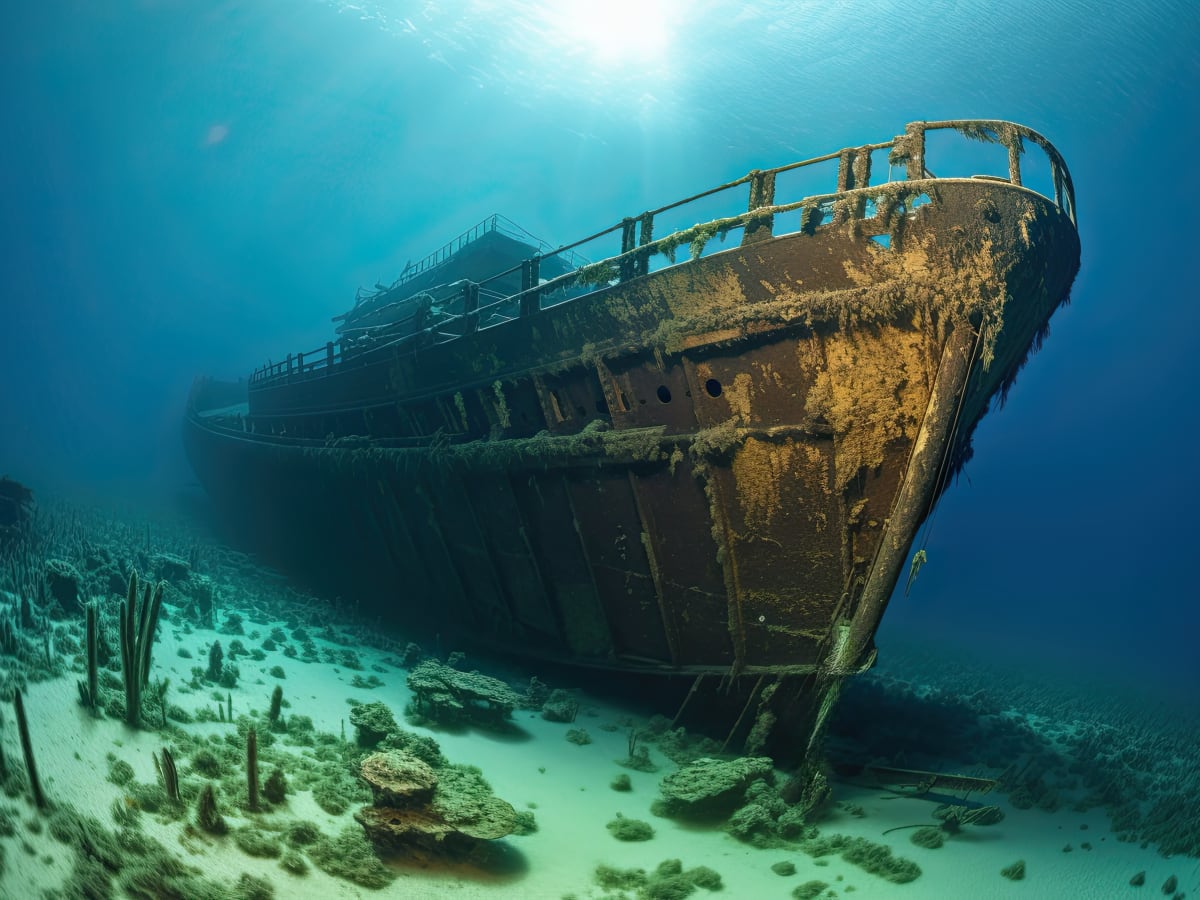
Why a rusty hull on the seabed can be a protected historical treasure—or just scrap metal—depends on where you are and how the law defines a “wreck.”

Quick definition (TL;DR)
A shipwreck is the remains of any ship—or its cargo—that has been wrecked, sunk, stranded or abandoned in navigable waters. Under many heritage laws, it only becomes protected underwater cultural heritage after it has been submerged for 100 years. UNESCO Documentsmarinedebris.noaa.gov
1. The three lenses you need to know
| Lens | Governing rule | Why it matters |
|---|---|---|
| Every-day / dictionary | “The destruction or loss of a ship at sea.” | Media, pop-culture, casual speech. |
| Maritime-law | UK Merchant Shipping Act 1995 (see our in-depth guide to salvage law basics) | Decides salvage rights & insurance payouts. |
| Heritage-law | UNESCO 2001 Convention ≥100 years old and culturally significant UNESCO | Determines permits, protected-site status. |
2. Flotsam, jetsam, lagan & derelict—do they count?
These four centuries-old nouns still shape wreck law today. UNESCO Documents
| Term | What it is | Is it a “shipwreck”? |
|---|---|---|
| Flotsam | Floating debris from a wreck | Yes—part of the wreck cargo. |
| Jetsam | Goods intentionally thrown overboard to lighten a vessel | Usually not a wreck unless attached to the hull. |
| Lagan | Sunken goods with a buoy/mark to reclaim later | Not abandoned → claimable by owner. |
| Derelict | Sunken or drifting vessel/cargo with no hope of recovery | Yes—classic shipwreck; subject to salvage or heritage rules. |
3. How old must it be?
- There is no single global age threshold.
- UNESCO 2001 Convention → ≥ 100 years under water. UNESCO
- UK Protection of Wrecks Act 1973 → age irrelevant; designation can happen tomorrow if a wreck is “of historical, artistic or archaeological importance.” marinedebris.noaa.gov
- US Abandoned Shipwreck Act 1987 → title transfers to the coastal State if the wreck is “abandoned” and “embedded” or “submerged” in State waters, regardless of age. marinedebris.noaa.gov
Rule of thumb for divers: If the hull has rested for 50+ years, assume permits or reporting duties may apply before removing artefacts.
4. Six common types of shipwrecks
| Type | Example | Special considerations |
|---|---|---|
| Catastrophic sinking | RMS Titanic | Often war graves or memorial sites. |
| Grounding/stranding | Costa Concordia | Environmental cleanup & insurance first. |
| Scuttled/artificial reef | USS Oriskany off Florida | Usually pre-cleared for diving; still heritage after 100 yrs. |
| War wreck | HMS Prince of Wales | Sovereign immunity may persist forever. |
| Derelict/abandoned | 19th-c. coal hulk in Cornish harbour | May fall under local nuisance or debris laws, not heritage. |
| Submerged cargo only | Bronze cannon field, no hull | Still covered by UNESCO definition if ≥100 yrs. |
Want to see where these lie? Explore our interactive shipwreck map for GPS pins and depths.
5. When a wreck becomes protected heritage
- Designation – UK Historic England can list a site under the Protection of Wrecks Act; diving may require a licence. UNESCO Documents
- Automatic title transfer – In the US, ASA 1987 hands ownership to the State; salvagers need permits. marinedebris.noaa.gov
- UNESCO convention waters – Ratifying States must prevent commercial exploitation of wrecks ≥100 yrs.
Tip: Always check both national and regional registers before disturbing anything—including a “souvenir” porthole.
6. Salvage rights vs. ownership in 60 seconds
- Salvage = the right to be paid for helping recover a wreck or cargo.
- Ownership = title to the wreck itself.
- A salvor can earn up to 100 % of the saved value only if the owner can’t be found or abandons claim.
- Warships and government vessels remain property of the flag State—no matter how deep, how old, or where. marinedebris.noaa.gov
7. Why definitions matter to divers, historians & You
- Legal safety – Misidentifying a protected site can mean fines or confiscated gear.
- Ethics & conservation – Removing artefacts destroys context; science loses data.
- Insurance & liability – Recovery costs, pollution risk and third-party damage hinge on whether the hull is classed as a “wreck” or an “operational vessel.”
- Search-engine visibility – Bloggers & researchers who use the correct terminology (“derelict sloop,” “lagan cargo field”) tap long-tail keywords with low competition.
8. Next dive 🚢
If you enjoyed this primer, get a new wreck story every Friday—complete with dive conditions, GPS pins and archive photos.
Updated 15 July 2025
Leave a Reply